 ••
••
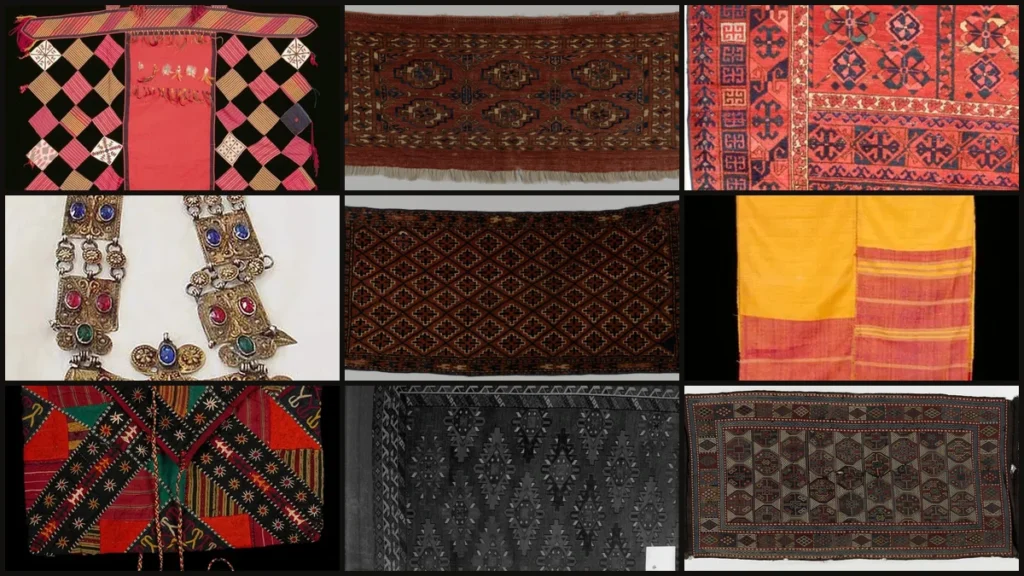
The early 1920s was a time when the nomadic way of life of the Turkmen tribes was gradually being replaced by Soviet collectivization policies, but the tradition of carpet weaving was still alive. This document is an example of folk art that depicts the leather and fabric decorations (trapping) for caravan animals — camels and horses. In Turkmen communities, horses and camels were not only means of transportation, but also symbols of status, wealth, and heroism. Created not in workshops but in homes and tents, with knowledge passed down from generation to generation, these works were part of the caravan culture. This image, which is a documentary photograph or archive document, carries a fragment of the lifestyle of that period to the present day.
This documentary work highlights the weaving, embellished leather, and painted decorations of a caravan saddle (horse or camel harness). The color palette includes dark red (sheep blood tone), indigo blue, green, and cream white, which are common in Turkmen carpets. Geometric motifs symmetrically placed in accordance with the animal’s anatomy stand out in the composition — usually gully (romboid) patterns and barbed lines — which are symbols of protection and abundance in Turkmen beliefs. The technical depth of the work reveals the meticulousness of handcrafting and the richness of the symbolic language, each motif carrying a meaning.


This work dates from a period when nomadic tribes were migrating along desert routes in the 1850s, weaving wool and silk threads on hand looms. The Yomud tribe lived in the highlands stretching from the southeastern shores of the Caspian Sea to the Karakum Desert, and was known for its distinctive weaving motifs. This pair of bags was an integral part of a bride’s dowry, prepared for marriage or as household furnishings; the joining of the two parts symbolized the union of two families and the integrity of the household. The weaving technique was the product of a body of knowledge passed down from generation to generation, and each motif conveyed the wearer’s height, status, and tribe. In this Turkmen society of the 19th century, women’s mastery of weaving was the most tangible expression of social value and cultural identity.
This work reflects the rich color palette and symbolic language of traditional Turkmen weaving. The bags, woven from a mixture of wool and silk, stand out with their vibrant red, navy blue, and white tones. Symmetry and repetition are the main features of the composition; the large, hooked “lake” motif placed in the center and the small geometric elements arranged along the edges represent the order of the universe and its protective forces. Each triangular and hooked form is associated with an amulet that protects against evil eyes and intentions. The choice of colors is not random: the colors of the earth and sky symbolize the continuity of life. These textiles are not just functional bags, but also sacred texts in which oral traditions are preserved, and in which stories and dualities are woven into the silk.

The nomadic life of the Türkmen people has created a cultural history shaped around portable dwellings such as tents and tents. These door covers, or “Ensi”, were objects that adorned the entrance to the family tent (ağ) and also served in marriage and community ceremonies. In the second half of the 19th century, especially in the ovals of Tejen and Merv, tribal groups such as Tekure, Yomut, Saryk and Erzeni, turned weaving and nakiş into a way of life. This work is part of a heritage that has been passed down from generation to generation through the handiwork of women. Door covers were considered as a boundary that symbolized the entrance to the tent for guests and visitors, and also reflected the status of the family and the identity of the tribe. In this context, the work is not only a decorative element, but also a socio-cultural text.
Türkmen tent door hangings are usually made by weaving together threads of wool; sometimes, they are made using a combination of silk and wool. In this piece, the geometric and floral motifs woven on a ground are interpreted as traces of the Kabil tribe’s distinctive “rose” (gül = medallion motif) design. The color palette is enriched with golden and orange accents on dark red, navy blue, and black tones, obtained through natural dyes. The vertical stripes that frame both sides of the door and the symmetrical composition in the center frame the entrance area like a “corridor,” offering a respectful welcome to the visitor. Symbolically, these motifs represent abundance, protection, and the cycle of nature, especially the “goat’s horn” (anga) and “rose” forms, which are associated with protective and nurturing powers in Turkmen beliefs.

In the 1850s, the Turkmen tribes, who migrated with their herds across the vast steppes from Horasan to the Karakum desert, had a social structure in which women’s craftsmanship was at the center of life. Turkmen women produced not only the carpets and kilims they wove in their tents, but also the jewelry they wore to adorn themselves and their families. Ornamental objects such as necklaces were not only a matter of beauty, but also a silent language that expressed the status of the family, the value of the bride’s dowry, and the woman’s place in society. During this period, Turkmen communities were undergoing major social and economic changes as a result of the expansion of the Russian Empire into Central Asia; migration routes were changing, and the forms of production and trade of handicrafts were evolving. In these conditions, the necklace produced is both a witness to a traditional aesthetic and a changing era.
This 1850 Turkmen necklace is an important part of the oral and visual heritage of Central Asia. The Turkmen jewelry tradition is a unique language that combines pre-Islamic beliefs, nomadic life, and women’s craftsmanship. Today, these objects are studied in global art museums and collections, both for their ethnographic and aesthetic value. The work reminds us to rethink the meaning of traditional crafts in the modern world and serves as an important reference point for the preservation of cultural diversity.

This Turkmen headscarf, made in 1966, is a reflection of the nomadic and semi-nomadic way of life that has been practiced in the deserts and semi-deserts of Turkmenistan for centuries. Turkmen tribes, especially those of the Tekke, Yomut, Çovdur and Saryk tribes, expressed their identity, tribal affiliation and social status through the motifs in the carpets and clothes they produced. This headscarf is a testament to the fact that traditional weaving and decoration practices remained alive in Soviet-era Turkmenistan. These works, created by women with their own hands, are not only everyday objects, but also cultural actors in which oral traditions are transmitted and motifs are passed down from generation to generation. The date of 1966 coincides with a period in which the effects of the Soviet era’s modernization policies on Turkmen folk art were felt; however, this headscarf demonstrates the resilience and vitality of traditional Turkmen aesthetics.
This work, recorded as a documentary photograph and archival document, reveals the intricacies of the Turkmen weaving tradition. The headscarf is made using the hand-weaving technique, with yarn or silk threads. The characteristic features of Turkmen weaving, such as knots and weaving techniques, are clearly visible in the work. The colour palette consists of the unmistakable colours of Turkmen weaving: dark red (wheat), navy blue, green, and white, which are obtained through natural dyes and offer deepening and richening tones over time. The composition is woven with a symmetrical and geometric motif, and tribal symbols appear on the edges and surface of the headscarf. These motifs – such as the rectangular areas called ‘göl’ (lake), the ‘ram’ (horn) motif, and other protective symbols – carry both decorative and protective, magical meanings. Each motif serves as a linguistic element that encodes the identity, cube, and belief system of the person wearing it.
This 1966 Turkmen headscarf is a living document of Turkmen folk art and weaving tradition. When evaluated from the perspective of art history, it can be said to be an important example that demonstrates the continuity of traditional Turkmen aesthetics during the Soviet period. Today, such works documented in museum collections and archives play a critical role in passing on the oral and practical art tradition to future generations. The digitisation of such public domain works by institutions such as LastMuseum enables the global recognition of Turkmen and Central Asian weaving art and deepens academic research. The work is not just a headscarf, but also a living witness to a culture, a people, and centuries of labour.
The Immortal Word of Sand and Silk: The Mysterious Face of the Turkish Knot Bag Face

Turkmen weaving is an artistic tradition that carries the nomadic heritage of Central Asia; this work draws from the same roots. In traditional Turkmen society, women wove carpets, kilims, and bags to decorate their tents and living spaces, using knowledge passed down from generation to generation. Known as bag faces, these pieces often form the front of shoulder bags or storage boxes and serve both a functional and decorative purpose. Each motif functions as a verbal code that carries the wearer’s tribe, status, and beliefs. This work is a reflection of the nomadic way of life of the Turkmen people historically; weaving is at the center of social life as a manifestation of women’s labor and the accumulation of cultural memory. Color and form are maintained as a language preserved over generations.
This work was created using the traditional hand-knitting technique, using yarn or silk threads. The characteristic features of Turkmen weaving, such as knots and weaving methods, form the structure of the work. The color palette includes earth tones derived from natural dyes, such as dark red, copper, black, and white. These colors are obtained from natural dyes derived from plant and animal sources. In the composition, geometric patterns arranged symmetrically around a central face motif stand out. The face motif is often considered a protective symbol and is believed to ward off evil. The symbolic layers of the work are related to the Turkmen beliefs of nazar and protection; each geometric element is a reflection of the way the community perceives the world.

The early 1920s were a time when the centuries-old nomadic way of life of the Turkmen communities was shaken by Soviet collectivization policies and the imposition of a settled lifestyle, and the old nomadic order was gradually disintegrating. This headscarf is a witness to a textile tradition that has been handed down from generation to generation by Turkmen women living on the edges of the Karakum Desert and along the shores of the Caspian Sea. Each Turkmen tribe – Yomut, Teke, Ersari, Saryk – expresses its identity through symbols and colors specific to the items it weaves, and this piece is also part of the process of transition from oral to written culture during that period. The rope-woven weaving techniques used by women reflect the tangible traces of a life that extends from tent construction to homes, from migration routes to settled villages.
This documentary-style photograph reveals the weaving structure and knitting technique of the headscarf. Made using the rope knitting and cord weaving techniques common in Turkmen textiles, the piece has a geometric rhythm created by the interlacing of fine threads. The colour palette reflects an aesthetic inspired by natural dyes, with earth tones – chestnut, ochre, burgundy and cream – drawn from nature. The repeating motifs in the composition are filled with eye motifs and geometric figures that are read as protective symbols in the Turkmen world; each pattern carries the wearer’s height, status, and belief in protecting the world from evil spirits. These symbolic layers transform the garment from being an ordinary piece of clothing into a document of faith and identity.

The year 1900 marks a period when the traditional nomadic way of life of the Turkmen peoples was still alive, but Western influence was slowly penetrating the depths of Central Asia. This date witnesses one of the most brilliant periods in the history of Turkmen handicrafts, for in this period, decorations on fabrics and leather were not only aesthetic, but also served as carriers of social status, beliefs, and protective symbols. Cases for the Quran were among the most valuable heirlooms of Turkmen families; they were produced as an integral part of the dowry given to a daughter at the time of her marriage, and were passed down from generation to generation. This work is a product of the workshop tradition of semi-nomadic Turkmen peoples, rather than the home production culture, and reflects the craftsmanship of housewives, along with the carpets and embroidery they wove. In 1900, the Teke, Yomut, Çevir, Saryk, and Ersari tribes living in the plains of the Urgench and the northern Caspian Sea region decorated such religious items in a way that reflected their tribal identities. The production of Quran cases was also considered an act of faith and respect; the preservation of the holy text was considered a spiritual responsibility.
This work combines the most distinctive techniques of the Turkmen weaving and embroidery tradition. The covers, usually on a dark blue or black background, stand out with their characteristic motifs woven with gold and green thread. On the surface of the work, the 'rose' (flower) motifs, which are the signature of Turkmen art, are striking with their symmetrical and repetitive geometric structures; these motifs identify the tribes, varying in color and form. The 'goat horn' (ram horn) motif, located on the edges of the cover, is depicted as a protective and powerful symbol; it also represents abundance and the vitality of nature. The color palette predominantly uses natural dyes to create shades of blue, green, red, and golden yellow; these colors are interpreted in Islamic art as symbols of spirituality, the Garden of Eden, and divine light. This lithographic document allows us to observe the work’s tactile depth and the reflection of the embroidery on the fabric; the large rose medallion in the center of the composition creates a harmonious hierarchy with the smaller motifs around it. Each line and each color is a visual reflection of the respect for the sacred text.
This 1900 Turkmen Koran cover is an important document of Central Asian handicrafts and Islamic decorative art. The work holds a special place in art history for its ability to convey the artistic expressions, belief system, and everyday life culture of Turkmen tribes. Today, works of this kind are preserved in museums and private collections in order to preserve the heritage of nomadic culture and women’s handicrafts. These motifs, which serve as an inspiration for modern designers and textile researchers, are a living carrier of Turkmen identity in the global art world. The work also serves as a witness to an oral and written history, making valuable contributions to historical research.
1795 Türkmen Halısı: Dokunmuş Bir İmparatorluk Öyküsü ve Boyalı Desenin Sessiz Fısıltısı

In the late 18th century, in the heart of Central Asia, Turkmen tribes were nomadic, living in a vast geography stretching from the eastern shores of the Caspian Sea to the mountains of Turkistan. During this period, Turkmen tribes such as Horasan, Teke, Yomut, Çovdur, and Saryk were a kind of oral historian, expressing their identity and heritage through their unique geometric motifs woven into their own distinctive weaving traditions. The year 1795 coincided with one of the most productive periods of this deeply rooted weaving culture. Turkmen women were weaving carpets in vertical looms, in their tents and homes, in a rhythm that was in harmony with the daily life. This work stands as a tangible witness to the socio-cultural life of the period, the tribal hierarchy, and nomadic life. Carpets were also used as wedding gifts, as a means of accumulating property, and as objects of spiritual protection.
This work is woven from natural and vegetable dyes on a fabric made of wool, with a silky sheen. The colour palette stands out with vibrant shades of deep navy or black on a white background, characteristic of Turkmen carpet weaving. The composition is woven with conservative motifs in a symmetrical and geometric arrangement, centred on a medallion or placed in the corners. Each geometric form in the work carries deep symbolic meanings: the arrow and spear-shaped motifs represent heroism and protection, while the toothed edges represent the dog and the spirit that protects it. The karemsi motif, known as Elipbe, combines the spirit of protection of the tribe with its ancestral heritage. Each knot in the weave is worked like a letter, carrying the beliefs, wishes and life philosophies of the masters.

In the first half of the 19th century, the Turkmen tribes lived in a semi-nomadic way in a vast plain and desert region extending from the western shores of the Caspian Sea to the interior of Turkmenistan. This period was a time when the weaving art of the tribal units, such as Tekke, Çavuş, Saryk, Yomut and Ersari, became an identifier, and the carpet was not only a household item but also a summary of the family, tribe and religious world. The interior of the tent structures called otağs served as a model of the cosmic order along with each carpet woven, and the carpet was the most important object that combined the practical needs of nomadism with a cosmic worldview. This work, as a product of this cultural and economic structure, was woven in tribal workshops, mostly by women, and passed down from generation to generation with a body of knowledge.
The work stands out with an intense and saturated color palette: the gul, a flower or shield-shaped motif with curved, hooked petals, placed on a deep plaster (dark red or burgundy), is intertwined and repeats endlessly, creating a rhythmic, breathing space at the center of the weave. The gul is the heart of the Turkmen carpet, and each tribe has its own unique form of gul; this work reflects the principle of infinite repetition in the form of a gul series arranged in a springing, advancing series, with the ends connected and not breaking. The dambord pattern, the striped/checked border of the work, serves as a geometric boundary that organizes the space and places it in a universal order. The density of the threads, the density of the knots, and the natural coloring of the wool have given the work both a tactile depth and a long-lasting durability.
This Turkmen carpet is a living witness to the oral and visual heritage of Central Asian weaving art; each gul represents the identity of a tribe, and each design motif represents a network of knowledge passed down from generation to generation. In art history, it is considered an important example of a tradition in which abstract geometry and spiritual symbolism form a perfect whole, and today it remains one of the rare works that convey the aesthetic and philosophical depth of the nomadic culture, both in museum collections and at the center of studies on global art history.
📊 Comparative Cultural Matrix of the Works Under Review
| Title | Artist / Craftsman | Period / Year | Type / Technique | Editorial Quality |
|---|---|---|---|---|
| Camel or Horse Trapping | Unknown | 1920 | Turkmen | The Immortal Pattern of the Sands: 1920 Turkmen Caravan Bag Documentary |
| Bag, Yomud tribe, pair with 1943.1741 | Unknown | 1855–1865 | Turkmen | The Language of Sand and Silk: 1855 Bag Pair from the Yomud Turkmen |
| Tent Doorway Cover (Ensi) | Unknown | Turkmen | The Language of Sand and Silk: Oral Legend on the Tent Doorway Cover (Ensi) of the Turkmen | |
| Necklace | Unknown | 1850–1899 | Turkmen | 1850 Turkmen Necklace: The Heartbeat of the Desert, Gold and Pearl Motifs |
| Chyrpy (Head covering) | Unknown | 1966–1999 | Turkmen | The Language of Sand and Silk: 1966 Turkmen Headscarf — Documentary Headscarf from LastMuseum |
| Ersari Bag Face | Unknown | Turkmen | The Immortal Word of Sand and Silk: The Veiled Face of the Turkmen Bag | |
| Head shawl |























لا توجد تعليقات حتى الآن